
Resume vs Cover Letter: What’s the Difference?
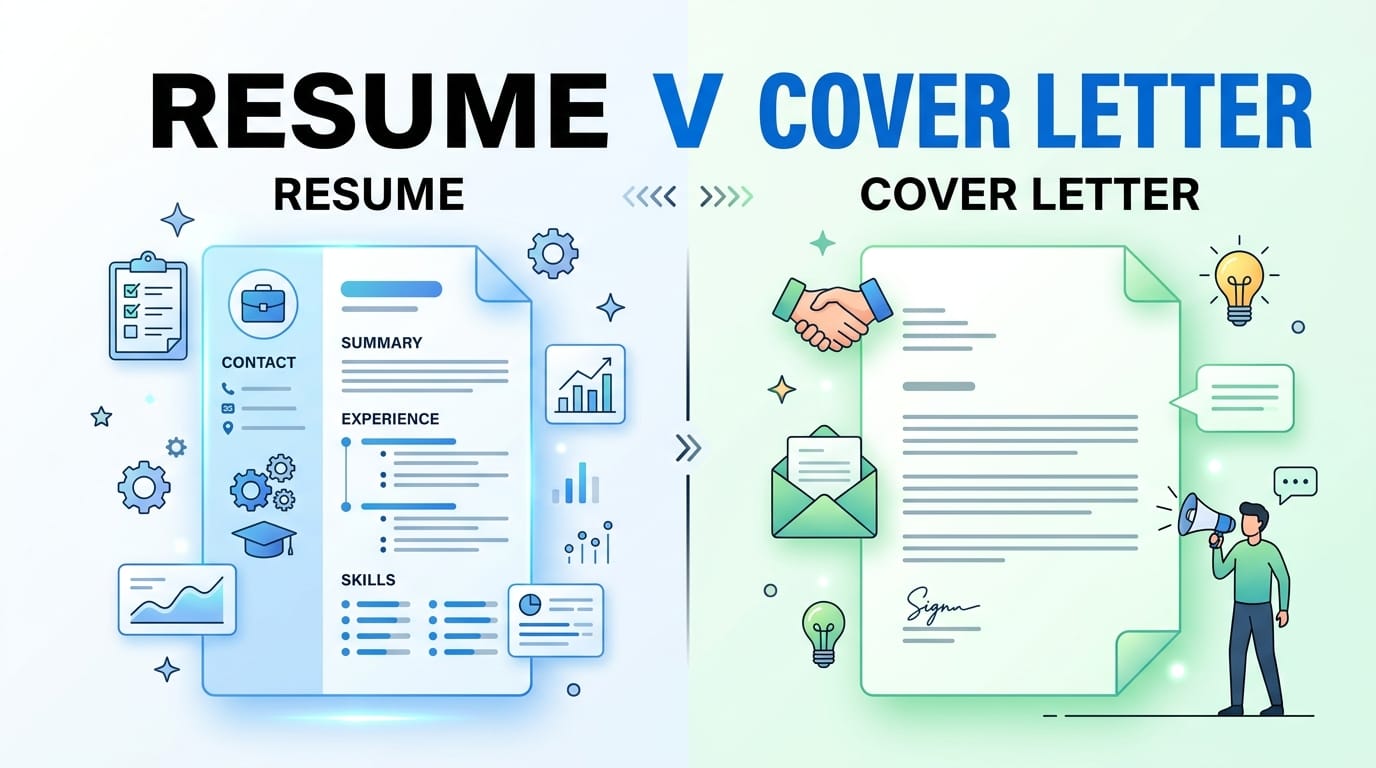
A resume and a cover letter are both used in job applications, but they serve different purposes. A resume summarizes your experience, skills, education, and achievements, while a cover letter explains why you're interested in a specific role and why your background makes you a strong fit.
In simple terms, your resume shows what you've done, while your cover letter explains why it matters for the job you're applying for.
Here's a quick look at the difference.
Resume vs Cover Letter: What’s the Difference?
The main difference between a resume and a cover letter is their purpose.
A resume provides a structured summary of your experience, skills, education, and qualifications. A cover letter provides context by explaining why you're interested in the role and why your background makes you a strong candidate.
In simple terms:
Resume = what you've done.
Cover letter = why you're a strong fit for the role.
Your resume highlights your experience, skills, and achievements, while your cover letter explains your motivation and connects your background to the employer's needs.
So, when comparing a resume vs cover letter, neither document replaces the other. They serve different purposes and work best when used together.
Resume vs Cover Letter: Quick Comparison
| Resume | Cover Letter | |
|---|---|---|
| Main purpose | Summarizes your qualifications and experience | Explains your interest and fit for a specific role |
| Format | Sections, headings, and bullet points | Letter-style paragraphs |
| Main focus | Skills, experience, education, and achievements | Motivation, relevant experience, and career fit |
| Length | Usually 1–2 pages | Usually around 1 page |
| Tone | Concise and factual | Professional and personalized |
| Customization | Tailored to the job | Tailored to the specific employer and role |
| Use | Provides evidence of your qualifications | Adds context to your application |
What Is a Resume?
A resume is a structured document that summarizes your:
- Work experience
- Skills
- Education
- Certifications
- Achievements
- Technical qualifications
Its main purpose is to help recruiters quickly understand whether you meet the requirements for a role.
A strong resume is usually:
- Concise
- Easy to scan
- Achievement-focused
- Tailored to the role
In modern hiring, resumes are also commonly analyzed by ATS and AI screening systems before recruiters even review them manually.
That means formatting, keywords, and relevance all play a major role in whether your application gets noticed.
Candidates struggling with resume structure or ATS optimization can use Preplink.ai Resume Builder to create more organized, ATS-friendly resumes.
Read How to Write a Resume for Job Applications in 2026
What Is a Cover Letter?
A cover letter is a personalized document submitted alongside your resume.
Instead of listing qualifications, it focuses on:
- Explaining your interest in the role
- Highlighting relevant experience
- Showing personality and motivation
- Connecting your background to the company’s needs
A cover letter gives context that a resume alone often cannot provide.
For example:
- Career transitions
- Employment gaps
- Industry changes
- Strong motivation for a company or role
Unlike resumes, cover letters are written more conversationally and are usually customized for each application.
According to Princeton University’s Cover Letter Guide, an effective cover letter should be individualized and connect your qualifications and motivations to the employer's needs.
Resume vs Cover Letter: Key Differences
Although both documents support the same job application, they work differently. The biggest differences are their purpose, format, content, length, and level of personalization.
1. Purpose
A resume gives employers a structured overview of your professional background.
A cover letter explains why you're interested in the position and how your experience relates to the role.
Think of it this way:
Resume: Here's what I have done.
Cover letter: Here's why my experience is relevant to this role.
2. Format
Resumes are usually divided into sections such as:
- Professional experience
- Education
- Skills
- Certifications
- Achievements
They often use bullet points to make information easy to scan.
Cover letters, on the other hand, are written in a letter format using paragraphs. They normally include an introduction, a few body paragraphs, and a closing.
3. Content
Your resume focuses on facts about your professional background, including your previous roles, responsibilities, achievements, skills, and education.
Your cover letter gives you more space to explain the story behind those qualifications. You can use it to highlight a particularly relevant achievement, explain a career change, or show why you're interested in working for a particular company.
4. Length
A resume is commonly one to two pages, depending on your experience and the requirements of the role.
A cover letter is usually around one page. It should provide useful context without becoming a lengthy explanation of your entire career.
5. Personalization
Both documents should be relevant to the job you're applying for, but cover letters are generally more directly personalized to the specific employer and position.
Your resume might require adjustments to emphasize certain skills or achievements. Your cover letter should clearly explain why this particular role and company interest you.
Do You Need a Resume, a Cover Letter, or Both?
In most job applications, your resume is the primary document because it provides an overview of your qualifications and experience.
A cover letter is useful when the employer requests one or when additional context can strengthen your application.
A cover letter can be particularly helpful for:
- Career switchers
- Candidates with limited experience
- Applicants explaining employment gaps
- Candidates applying for competitive roles
- Applicants with a strong reason for wanting to work for a particular company
However, not every job requires a cover letter. Always check the application instructions before deciding whether to include one.
Can a Cover Letter Replace a Resume?
No. A cover letter does not replace a resume.
Your resume provides a structured overview of your skills, experience, education, and achievements. Your cover letter adds context by explaining your interest in the role and connecting your background to the employer's needs.
When an employer asks for both documents, submit both rather than using one as a substitute for the other.
The two documents should complement each other rather than repeat the same information.
Common Resume Mistakes Candidates Make
Many job seekers unintentionally weaken their resumes by:
- Listing responsibilities instead of achievements
- Using poor formatting
- Writing vague descriptions
- Failing to tailor resumes for roles
- Overloading resumes with unnecessary information
These issues can make your resume harder to scan and less relevant to the role.
Preplink.ai Resume Scan helps identify resume weaknesses, keyword gaps, and formatting issues that may reduce interview opportunities.
Read Resume Mistakes to Avoid in 2026
Common Cover Letter Mistakes Candidates Make
Cover letters can also hurt applications when written poorly.
Some common mistakes include:
- Copying generic templates
- Repeating the resume word-for-word
- Making the letter too long
- Focusing too much on personal needs instead of employer value
- Sounding robotic or overly formal
A good cover letter should feel:
- Specific
- Clear
- Professional
- Personalized
Recruiters can usually tell when a cover letter was written specifically for the role versus copied and reused everywhere.
Should You Tailor Your Resume and Cover Letter?
Yes. You should tailor both documents to the role you're applying for, although the type of customization will be different.
For your resume, this can mean adjusting:
- Keywords
- Relevant achievements
- Skills
- Professional experience
- The order or emphasis of information.
For your cover letter, personalization can involve explaining why you're interested in the specific position, referencing the company's needs, and highlighting experience that directly relates to the job.
Tailoring doesn't mean rewriting everything from scratch for every application. It means making sure the information you present is relevant to the position.
Resume vs CV vs Cover Letter
A resume and a CV can sometimes refer to similar documents, depending on the country and employer.
In some markets, a CV is a more detailed record of your academic and professional background, while a resume is usually a shorter, job-focused summary.
A cover letter is different from both. It is a personalized letter explaining your interest in a specific position and how your experience relates to the role.
The terminology can also vary between countries and employers, so always check the application instructions to see which document is requested.
Resume vs Cover Letter: Final Takeaway
A resume and a cover letter may be submitted together, but they serve different purposes.
Your resume summarizes your qualifications, experience, skills, and achievements. Your cover letter provides context about your interest in the role and why your background is relevant.
If an employer requests both, make sure each document adds something different rather than repeating the same information.
The key is simple:
Use your resume to show what you've done and your cover letter to explain why it matters for the role.
And when you're preparing your next application, make sure both documents are tailored to the position rather than sending the same version everywhere.