
How to List Education on a Resume: Examples and Tips
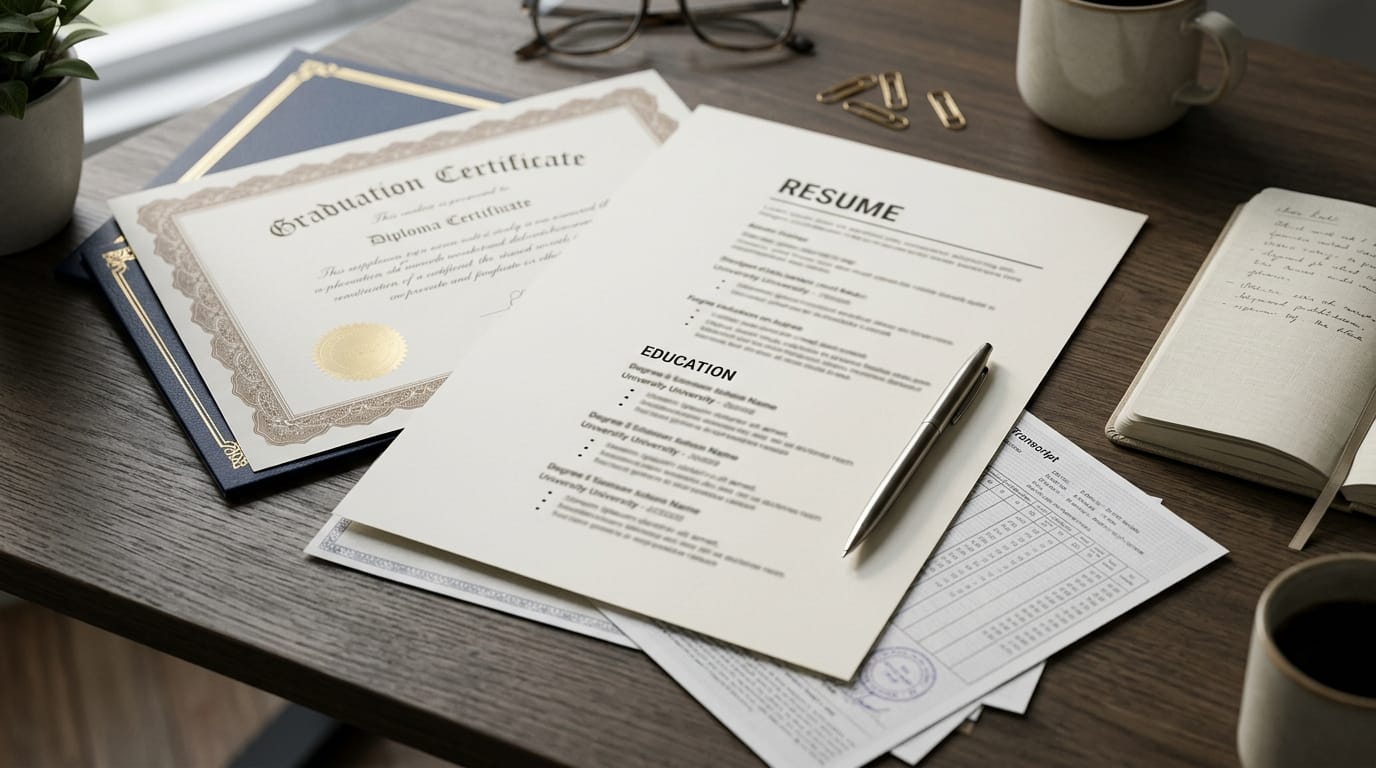
Your education section may be one of the simplest parts of your resume, but getting the details right matters.
For a recent graduate, student, or someone applying for a role that requires a specific qualification, education can be one of the first things an employer looks for. For an experienced professional, it may take up less space because your work history carries more weight.
The key is knowing what to include, what to leave out, and how much detail your background actually needs.
What Should You Include in the Education Section?
A typical education entry includes four main pieces of information:
- Degree or qualification
- School or institution
- Location
- Graduation date or expected graduation date
For example:
Bachelor of Science in Computer Science
University of Michigan, Ann Arbor, MI
Graduated: May 2025
If your degree is still in progress, make that clear:
Bachelor of Arts in Marketing
Boston University, Boston, MA
Expected Graduation: May 2027
You can add other details, such as GPA, honors, awards, or relevant coursework, when they strengthen your application.
How to Format Education on a Resume
Keep the education section simple and easy to scan.
A useful format is:
Degree or qualification
School Name, Location
Graduation date or expected graduation date
List your education in reverse chronological order, starting with your most recent or highest relevant qualification. This makes it easier for employers to see your latest credentials first.
For example:
Master of Business Administration
University of Texas at Austin, Austin, TX
2024
Bachelor of Science in Business Administration
Texas State University, San Marcos, TX
2021
You don't need to write a paragraph explaining each degree. The section should provide the important information quickly.
If you're building your resume from scratch, Preplink.ai Resume Builder can help you organise your education, experience, skills, and other sections into a complete resume.
Where Should Education Go on a Resume?
There isn't one correct position for every candidate.
If you're a recent graduate or have limited work experience, education can appear near the top of your resume because it may be one of your strongest qualifications.
If you've been working for several years, your professional experience will usually deserve more attention, so education can appear below it.
The job itself also matters. If a position requires a particular degree, license, or academic qualification, placing that information where it's easy to find can make sense.
For example, a recent graduate might use:
Summary → Education → Work Experience → Skills
An experienced professional might use:
Summary → Work Experience → Education → Skills
The goal isn't to follow one universal resume formula. It's to put the information that matters most to the employer where they can find it quickly.
How to List a Degree You're Still Completing
You can absolutely list a degree that you're currently working toward. Just don't make it look as though you've already graduated.
Use wording such as:
Bachelor of Science in Information Technology
University of Florida, Gainesville, FL
Expected Graduation: May 2027
You can also add relevant coursework if you don't have much professional experience:
Relevant coursework: Database Management, Web Development, Systems Analysis
If your graduation date isn't certain, you can simply use “Expected Graduation: 2027” rather than giving a month.
How to List an Unfinished Degree
If you attended college but didn't complete the degree, you can still include the education if it adds value to your application.
The important thing is not to imply that you earned a degree you didn't complete.
For example:
University of Colorado Boulder, Boulder, CO
Completed coursework toward a Bachelor of Arts in Economics, 2021–2023
If you completed substantial coursework that is relevant to the job, you can mention it:
Relevant coursework: Microeconomics, Statistics, Financial Accounting
This can be particularly useful when the education supports the skills required for the role.
Should You Include Your GPA, Coursework, or Honors?
Not everyone needs to include these details.
GPA
A strong GPA can be worth including if you're a recent graduate or have limited professional experience. If you've been working for several years, your GPA is usually less important.
There's no need to include a mediocre GPA simply because you have the space.
Relevant Coursework
Coursework can help students and recent graduates demonstrate knowledge they haven't yet gained through full-time employment.
For example:
Relevant coursework: Consumer Behavior, Digital Marketing, Market Research, SEO
Only include courses that connect to the job you're applying for.
Honors and Awards
Academic honors can strengthen your education section, particularly early in your career.
For example:
Dean's List, 2024–2025
Academic Excellence Scholarship
Once you have substantial professional experience, these details may no longer need to take up valuable resume space.
Should You Include High School?
If you've earned a college degree, you generally don't need to include your high school education.
For example, there's little value in writing:
Lincoln High School, Chicago, IL
Graduated: 2019
University of Illinois Chicago
Bachelor of Arts in Psychology, 2023
Once you've completed a higher-level qualification, your college or university education is usually more relevant.
High school can still belong on your resume if it's your highest level of education or you're currently a high school student.
How to List Multiple Degrees
If you have more than one degree, list each one separately.
For example:
Master of Science in Data Analytics
Northeastern University, Boston, MA
2025
Bachelor of Science in Mathematics
University of Massachusetts Amherst, Amherst, MA
2021
You don't need to give every degree equal space. If one qualification is much more relevant to the job, you can give it more prominence.
What About Certifications and Online Courses?
Certifications, bootcamps, online courses, and professional training can strengthen your resume, but they don't necessarily belong in the main education section.
If you have several professional certifications, a separate Certifications or Professional Development section may be clearer.
For example:
CERTIFICATIONS
Google Analytics Certification — Google, 2026
HubSpot Content Marketing Certification — HubSpot, 2025
This keeps your formal education separate from shorter professional credentials.
For more guidance, see How to List Certifications on a Resume: Examples and Tips.
Education Section Examples
Recent Graduate
Bachelor of Science in Marketing
University of Georgia, Athens, GA
Graduated: May 2026
GPA: 3.7
Relevant coursework: Digital Marketing, Consumer Behavior, Market Research
Experienced Professional
Master of Business Administration
University of California, Irvine, CA
2018
Bachelor of Science in Finance
San Diego State University, San Diego, CA
2014
Current Student
Bachelor of Science in Computer Science
Arizona State University, Tempe, AZ
Expected Graduation: May 2028
Relevant coursework: Data Structures, Algorithms, Database Systems
Unfinished Degree
University of Washington, Seattle, WA
Completed coursework toward a Bachelor of Arts in Communications, 2021–2023
Common Education Section Mistakes
A few small mistakes can make the section harder to read or less useful.
Listing too much information: Your resume doesn't need every class, club, or academic activity you've ever participated in.
Hiding an in-progress degree: Make your expected graduation date clear.
Claiming a degree you didn't earn: Be accurate about unfinished education.
Keeping high school information forever: Once you have a higher-level qualification, high school usually no longer needs to appear.
Using inconsistent formatting: Keep degree names, dates, locations, and school names formatted consistently throughout the section.
Ignoring the job description: If the employer specifically asks for a particular degree, specialization, or qualification, make sure your education section makes that information easy to find.
Before submitting your resume, you can use Preplink.ai Resume Scan to identify areas that may need improvement and make sure your resume is ready for the role.
Final Thoughts
A good education section doesn't need to be complicated. It should give the employer the qualification, institution, and date they need, while making relevant academic achievements easy to spot.
The amount of detail you include should depend on your career stage. A recent graduate may benefit from adding coursework, honors, or GPA, while an experienced professional can usually keep the section much shorter.
Most importantly, treat your education section as part of the larger resume, not a standalone list of everything you've studied. Give more space to the qualifications that actually support the job you're applying for, and remove details that no longer add value.